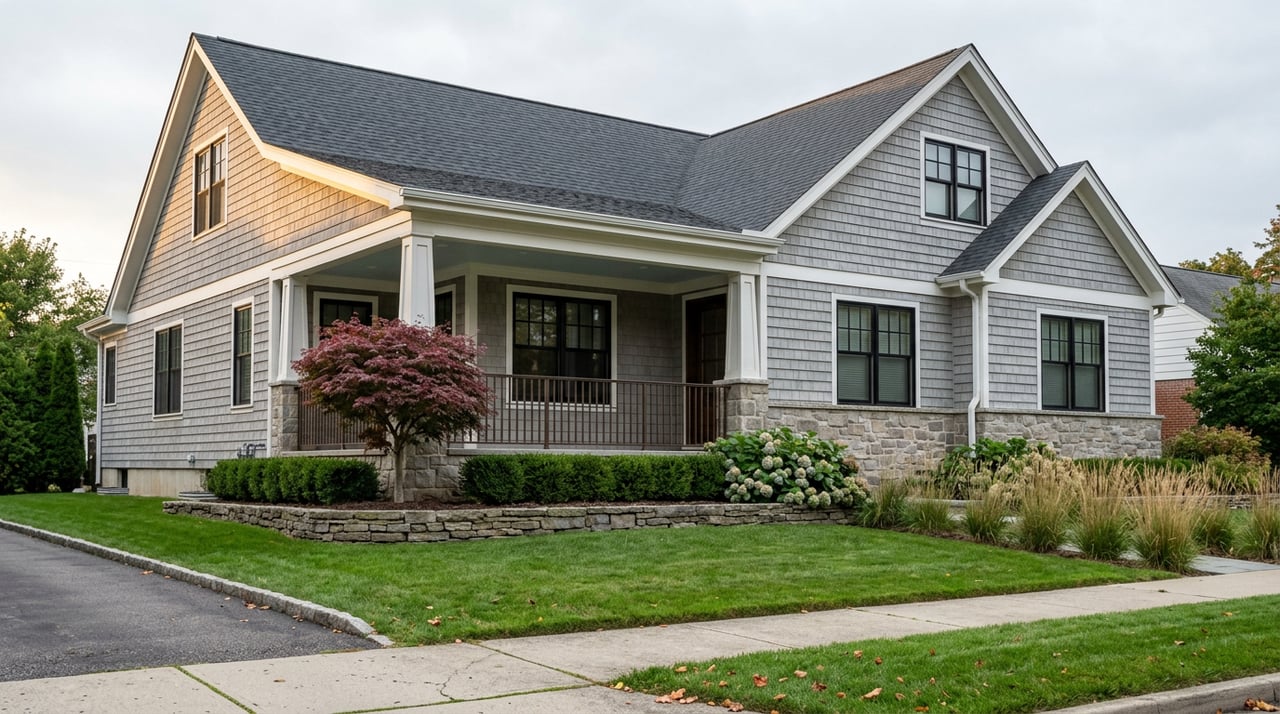
Shoreline's Median Price Is Falling. The House Isn't What's Losing Value.
September 24, 2026
September 24, 2026
A family in Ridgecrest inherits a rambler two blocks from the Shoreline South/148th light rail station. It is a modest 1960s house, the kind that used to sell for what any similar rambler in Shoreline sold for. They expect a normal home sale, a normal appraisal, a number that matches the comps down the street. Instead they find out the lot itself, sitting inside the city's transit-area zoning overlay, is worth more as a development site than the house sitting on it ever was as a house. That gap is not a quirk. It is the story of Shoreline's housing market right now, and it explains a number that has been confusing people who only read the headline.
Shoreline's median sale price is down year over year. As of the June 2026 pull from the Northwest Multiple Listing Service, the median closed sale sat at $757,500, with 119 active listings and roughly 2.3 months of inventory citywide. At the same time, price per square foot is rising. That combination looks like a contradiction until you understand what is actually changing about what sells.
A falling median with a rising price per square foot is not a market cooling off. It is a market where the average size of what closes is shrinking. Smaller, station-adjacent homes and townhomes are pulling a larger share of transactions than they did two years ago, and smaller homes drag the median down even while buyers pay more per square foot for the ones that trade.
The competitiveness underneath tells the same story. Homes in Shoreline are still moving in a median of nine days, and sale-to-list ratios are sitting at 100.8 percent, meaning the typical home is closing above its list price. That is not a market where sellers are losing leverage. It is a market where the product mix has shifted toward compact, walkable inventory near the two Link stations, and that inventory is getting bid up hard enough to keep the whole city's numbers looking tight even as the median heading south makes it look otherwise.
Mortgage rates help explain the timing. Freddie Mac's Primary Mortgage Market Survey put the 30-year fixed rate at 6.16 percent on January 8, 2026, down from 6.93 percent a year earlier. That swing was enough to pull first-time and move-up buyers back into exactly the kind of station-adjacent product that is now dominating the closing data.
The mechanism behind all of this is the Mixed-Use Residential zoning the city put in place around both Link stations, commonly shorthanded as MUR-70 and MUR-45. Within the tightest radius around the Shoreline South/148th and Shoreline North/185th stations, MUR-70 permits buildings up to roughly 70 feet, about six stories, with affordable housing units required as part of the deal. MUR-45, covering a broader ring around each station, allows structures up to 45 feet with the same affordable housing requirement attached.
What that means on the ground is visible in Ridgecrest today. The neighborhood around the 148th station has seen the most dramatic physical change in the city, with new apartment buildings both completed and under construction turning blocks that used to be uniformly single-family into a denser multifamily corridor. The clearest proof of how developers are pricing that opportunity is a pair of projects near NE 152nd Street. WZL Enterprises, a Mukilteo-based firm led by Marc Wislen, bought two facing sites there in 2021 for roughly 4.6 million dollars combined. One is now under construction as a seven-story, 35-unit building called Paramount. The other, Paramount Phase II, is working through permitting for a 110-unit project with 90 structured parking stalls. City planning documents from that period put the total development cap for the 148th station area at 2,214 units, which gives a sense of how much of Ridgecrest's future footprint is already accounted for on paper even before ground breaks on every parcel.
None of this touches Richmond Beach or Innis Arden the same way. Those neighborhoods price on Puget Sound views and lot size, not on proximity to a train platform, and that pricing logic has not changed. The mechanism driving Shoreline's median and price-per-square-foot split is a station-area story, not a citywide one, and it is worth knowing which side of that line your address falls on before you read too much into any single number.
For a while, the light rail effect on Shoreline was speculative. It no longer is. The 145th Street Corridor Project, which rebuilt the road connecting the 148th station to I-5, completed its first phase in June 2026: striping is finished, both roundabouts at the interchange are open with two lanes, and every lane on 145th is now open to traffic. Phase 2 design is at 60 percent, with a finalized design expected in 2027 and right-of-way acquisition already underway.
The pedestrian and bicycle bridge over I-5 at N 148th Street, a $43.6 million project, is even more visible proof of how real this has become. The bridge span itself is scheduled to be placed onto its piers overnight on September 26 or 27, 2026, with the bridge opening anticipated in early 2027. When it opens, it will give the west side of the freeway, currently cut off from the station by six lanes of interstate, a direct walking and biking connection to the platform.
Longer term, Sound Transit's planned Stride S3 bus rapid transit line is set to terminate at Shoreline South/148th when it opens in 2028, adding east-west service to Kenmore, Bothell, and the I-405 corridor. That would turn the 148th station from a rail stop into a genuine transit hub, which matters for anyone weighing whether today's walk-zone premium has more room to grow.
"We upzoned the area around our light rail stations to increase density, and we added green building standards" — Shoreline Mayor Chris Roberts
| Zone | Max height | Typical use | Affordable housing |
|---|---|---|---|
| MUR-45 | About 45 feet, roughly 4 stories | Townhomes, row houses, small mixed-use | Mandatory |
| MUR-70 | About 70 feet, roughly 6 stories | Mid-rise apartments and condos, ground-floor retail | Mandatory |
The zoning that exists today is not necessarily the zoning that will exist in a year. Housing development in both station areas has moved faster than the city originally planned for, and the housing thresholds built into the existing planned-action ordinances are close to being reached. That is why Shoreline is not starting from scratch but actively updating both subarea plans it adopted roughly a decade ago.
The city released a Draft Supplemental Environmental Impact Statement for the 185th Station Area on July 31, 2026, with the public comment period closing August 31. Updated subarea plans and code proposals for both stations are scheduled to move through the Planning Commission and City Council this fall and winter. If you own land inside either overlay, or you are shopping for a parcel with development potential, the decisions coming out of those meetings will set the zoning envelope for years. Buying or selling before that process resolves means pricing in some uncertainty about exactly how much density your parcel will eventually support.
For a buyer choosing between a station-adjacent townhome and an inland single-family home, the trade is genuinely different depending on what you are optimizing for. Station-adjacent attached product is where the appreciation pressure sits right now, driven by the mix shift described above. Inland single-family homes carry more negotiating room and, in many cases, room to add a detached accessory dwelling unit, which is its own form of optionality that a strictly station-driven valuation misses.
For a seller with a lot inside the MUR-45 or MUR-70 overlay, the development potential deserves to be the headline of your listing, not a footnote buried in the disclosures. A standard residential comp will not capture what a builder is willing to pay for an assembled or assemblage-ready parcel near either station.
For anyone managing an inherited property in Ridgecrest or North City, the stakes are higher than they used to be. Washington's estate tax exclusion for 2026 is $3,076,000 for deaths occurring between January 1 and June 30, dropping to $3,000,000 for deaths on or after July 1, with tax rates ranging from 10 to 20 percent on amounts above that threshold. Virtually all inherited real estate in Washington has to go through probate, which typically takes six months to a year, and during that window someone is responsible for taxes, insurance, and upkeep on a property that may be sitting vacant. When a station-area lot's true value reflects its development potential rather than its condition as a house, an estate that looked comfortably under the exclusion on paper can end up closer to the line than anyone expected.
How do I find out if my property is in the MUR overlay? The city's official zoning map is the only source that settles this with certainty. Station-area boundaries are parcel-specific, and being close to a station does not automatically mean a parcel carries MUR designation.
Does the upzoning change my property taxes today? Washington caps annual property tax levy increases at 1 percent for most taxing districts, which limits how quickly a rezoned parcel's assessed value translates into a higher tax bill, though assessed values themselves can still shift as comparable sales change.
Is every home near a station affected the same way? No. Walk-zone properties within roughly 0.4 miles of either station have captured the clearest lift. Homes farther out, and neighborhoods like Richmond Beach and Innis Arden that price primarily on view and lot, are following a different logic entirely.
If you are trying to figure out what your specific address is actually worth given where it sits relative to the 148th or 185th station, the zoning overlay it falls in, and where the city's subarea plan updates are headed this fall, that is exactly the kind of parcel-by-parcel analysis worth getting right before you list, buy, or make a decision about a property you have inherited. CJ Singh can walk through your specific address, the current NWMLS data for your block, and what the pending zoning decisions could mean for your timeline. Get a valuation or ask about access to off-market opportunities in Shoreline's station areas.
Stay up to date on the latest real estate trends.
Get assistance in determining current property value, crafting a competitive offer, writing and negotiating a contract, and much more. Contact CJ today to discuss all your real estate needs!